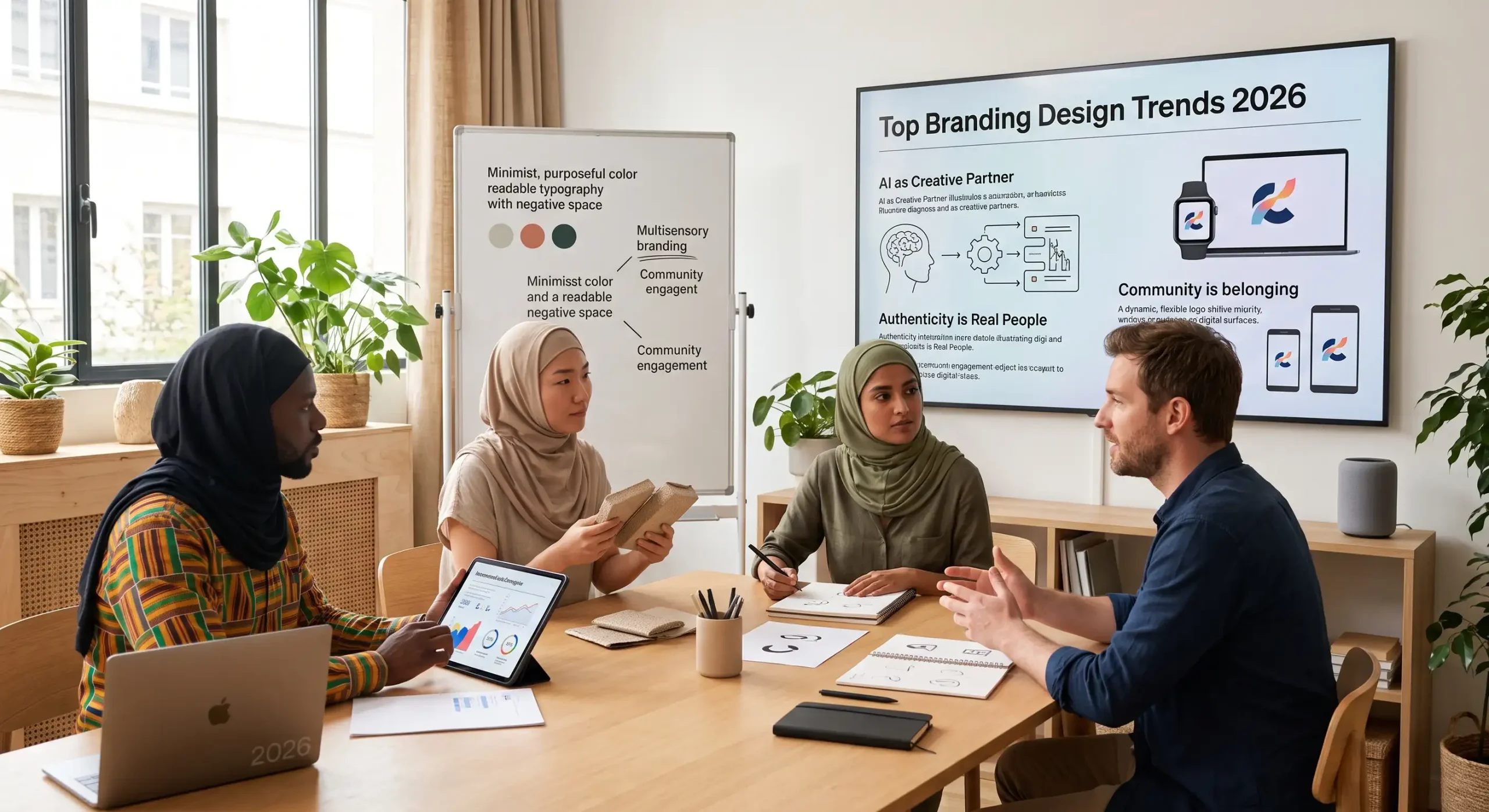
If you want your brand to remain distinctive and influential in the years ahead, understanding the branding trends of 2026 is essential. Technology, culture, and consumer behavior are changing at an unprecedented pace, forcing brands to rethink how they communicate with their audiences. If, until a few years ago, the primary focus was on visibility and capturing attention, today the central challenge is maintaining trust, building relationships, and creating memorable experiences.
According to the author, 2026 marks a point at which brands can no longer succeed through beautiful design or expensive advertising alone. Instead, they must be able to create a new meaning for their presence in a world shaped by artificial intelligence, cultural shifts, and information saturation.
-
AI Is Evolving from a Tool into a Creative Partner
One of the most important branding trends in 2026 is the full integration of artificial intelligence into the brand-building process.
While AI was primarily used in previous years to generate text or images, it has now reached a stage where it can contribute to market research, visual identity design, campaign development, audience behavior analysis, and even brand strategy.
However, the author emphasizes that this transformation also comes with a warning.
As content becomes easier to produce, brands will increasingly begin to look alike. Therefore, true value will no longer lie in the speed of production, but in the ability to create a distinctive point of view, personality, and meaning.
In other words, AI can be a tool for creation, but it is not the source of brand identity.
-
Authenticity Matters More Than Perfection
Today’s consumers are more likely than ever to trust brands that feel real.
They do not expect a brand to be flawless. Instead, they want to feel that real people are behind it.
For this reason, brands that acknowledge their mistakes, communicate transparently, and build honest relationships are more likely to earn trust than brands that are completely controlled and overly polished.
The author believes that the era of perfectly polished advertising messages is coming to an end, making way for more human forms of communication.
-
Brands Must Create Experiences, Not Just Content
In today’s world, almost anyone can produce content. However, creating memorable experiences is much more challenging to replicate. Successful brands of the future will focus on providing a consistent experience at every interaction with their audience—this includes everything from website design and packaging to physical stores, customer service, social media, and even how employees engage with customers. According to the article, a brand is no longer simply a collection of advertisements; rather, it is the totality of all the experiences people have with it.
-
Visual Identity Must Be Flexible
The era of completely static logos is over.
Brands today exist across a wide range of environments—from smartwatch screens and mobile apps to billboards, videos, conversational interfaces, and augmented reality.
As a result, the visual identity needs to adapt to different media without losing the brand’s personality.
From this perspective, the logo is only one component of a brand identity—not the entirety of it.
-
Design Is Becoming Simpler but Smarter
One of the most important design trends in 2026 is the move toward simplicity.
But simplicity does not mean eliminating personality.
Brands are seeking to remove unnecessary elements so that the core message can be communicated more clearly.
This simplicity includes:
- More readable typography
- Purposeful use of color
- Greater use of negative space
- Minimal yet warm design
- Flexible visual systems
-
Brands Need to Become Multisensory
One of the most interesting aspects of the article is its emphasis on multisensory experiences.
In the past, brands focused primarily on visual identity. Today, sound, movement, animation, texture, music, and even the tactile feel of a product are becoming part of brand identity.
For example:
- The sound a device makes when it powers on
- The music played when entering a store
- The texture of the packaging
- The way elements move within an app
All of these factors contribute to the mental image people form of a brand.
-
Community Matters More Than Audience
The article emphasizes that successful brands of the future will not simply acquire customers; they will build communities.
The distinction is important.
A customer makes a purchase, but a community member:
- Talks about the brand.
- Defends it.
- Shares their experience.
- Encourages others to use it.
Therefore, brands need to create an environment where people feel a genuine sense of belonging.
-
Sustainability Is No Longer a Competitive Advantage
A few years ago, a brand’s commitment to the environment could be considered a distinctive advantage.
Today, audiences increasingly see it as a basic expectation.
Simply claiming to be “environmentally friendly” is therefore no longer enough.
Brands need to demonstrate—with real evidence—how they are acting responsibly in practice.
-
Smart Personalization
Another major branding trend is the growing importance of personalization.
But personalization is no longer limited to product recommendations.
Brands are increasingly seeking to tailor:
- Content
- Design
- User experience
- Communications
- Offers
to the needs of each individual.
However, the article warns that personalization should not create a sense that the user’s privacy is being violated.
-
A Brand Must Have Meaning
Perhaps this is the most important message of the article.
In a world where everyone can produce good products and everyone has access to AI tools, what makes a brand memorable is the meaning it represents.
People do not simply buy products; they choose values, beliefs, and stories that they feel express something about their own identity.
Therefore, a brand needs to be able to answer the question:
“Why does our existence matter to the world?”
If the answer to this question is unclear, even the best design and the strongest advertising campaign cannot guarantee a brand’s long-term success.
Conclusion: The Future of Branding in 2026
This article argues that 2026 will mark the beginning of an era where the line between technology and humanity becomes increasingly blurred.
While artificial intelligence will take over various technical and executional tasks, this shift will elevate the value of distinctly human qualities such as creativity, empathy, storytelling, authenticity, and the ability to find meaning.
The successful brands of the future won’t just be those that achieve greater visibility; they will be the ones that establish a meaningful place in people’s minds and lives.
Beautiful design, advanced technology, and abundant content will only become truly valuable when they contribute to creating a coherent identity and fostering a lasting relationship with the audience.
Source
The Branding Journal
Article: Top Branding Design Trends 2026
Author: Marion Andrivet
Publication Date: January 2026